
The whole industry went paperless, and mostly that's a good thing. But after thirty years in this trade, I still print a copy of every journey, and I tell my travellers to do the same. Here is why a single sheet of paper still earns its place in your bag.
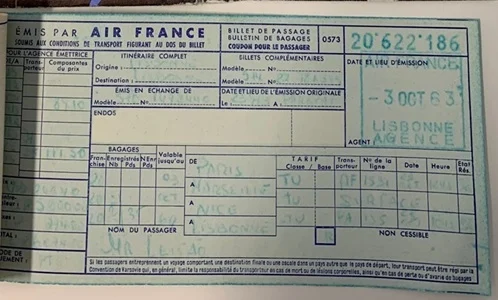
I still keep a few old paper tickets in a drawer at the office. Thick little booklets with red carbon leaves, the routing typed across the middle, a fare calculation only a handful of us could still read out loud. We stopped issuing those a long time ago, and I don't miss the carbon on my fingers. But every time someone tells me paper is finished, I think of the travellers who have rung me from an airport, in a small panic, wishing they had a printout in their hand. So let me make the unfashionable case, from a man who went fully digital years ago and still prints every trip.
One: your phone will pick the worst possible moment
A phone is a wonderful thing right up until it isn't. The battery that read forty per cent an hour ago is suddenly at four. The signal drops in the immigration hall, where there is never any signal, and the airline app chooses that exact moment to log you out and ask you to sign in again. I have watched a calm, capable traveller come apart at the gate because the boarding pass simply would not load, a queue building behind them and an agent waiting.
A printout has no battery, no signal, and no software update. It works in a basement immigration hall in a country whose network you have never joined. Print the boarding pass if the airline lets you, and always print the e-ticket and itinerary. It weighs nothing and it never crashes.
Two: some borders still want to see paper
We would all like to believe the whole world reads QR codes now. A good part of it does not, or will not on the day it matters. Plenty of airports still ask for a printed ticket before they will even let you into the terminal. Plenty of immigration desks, especially for a visa on arrival, want a physical copy of your onward or return flight and your hotel booking before they will stamp you in. “It's on my phone” is a sentence I have heard travellers say to an officer who has already put a hand out for paper.
Print your return flight, your first hotel's confirmation, and its address. Have it ready before you reach the desk, not buried in your inbox on airport Wi-Fi with a plane to catch. The officer waves you through, and you have lost nothing but a sheet of paper.
Three: when the systems go down, paper goes first
Every year or two an airline's computers fall over, or an airport loses power for an hour, and suddenly a very modern terminal is being run by hand. I have seen it. When that happens, the passengers holding a printed ticket and a booking reference are the ones the staff can process straight away, a boarding pass written out by hand, and off you go. The passengers with nothing but a dead app join a much longer, much slower queue while somebody tries to find their booking another way.
Your booking reference, that six-character code, is the single most useful thing to have on paper. With it, any airline desk in the world can find you in seconds. Write it down, print it, and keep it somewhere that isn't your phone.
A word for the romantics
There is a second reason I keep printing, and it has nothing to do with airport queues. A ticket used to be an object. You held your journey in your hand before you left, and you kept the stub long after you came home. I am not asking anyone to go back to carbon paper. But I would gently suggest the instinct behind it is worth keeping. A trip feels more real when some part of it exists off the screen.
So here is what we do
When you book a journey with us, you do not have to think about any of this. We hand you, or send you to print, a clean itinerary with every flight, every confirmation number, and every hotel with its address, all on one sheet. Keep it in your bag beside your passport. Nine times out of ten you will not need it, and the tenth time you will be very glad it is there.
Go paperless by all means. Just do not go paper-free. After thirty years of getting travellers home, that is the one old habit I would ask you to hold on to.